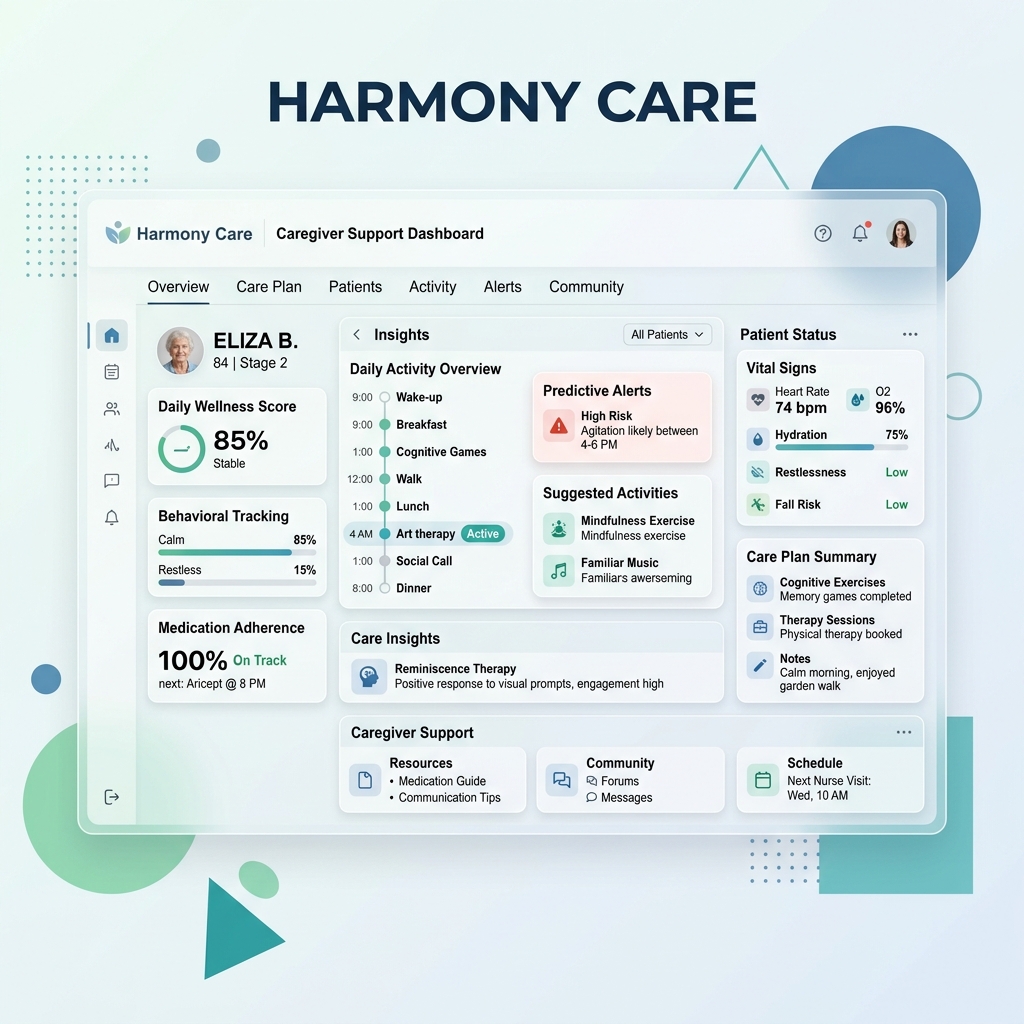
Dementia Caregiver App
Caregivers weren't just tired; they were suffering from decision paralysis.
THESTRATEGIC AUDIT
It started with a messy workbench of sticky notes. We observed that caregivers weren't just tired; they were suffering from decision fatigue. In our lab audit, we mapped the cognitive toll of managing multi-variant care routines. The core finding: users needed a system that breathes, not just a list of tasks.
THEHAPTIC RHYTHM PROTOTYPE
We implemented an experimental feedback loop called "Rhythmic Synchrony."
- Heartbeat UX: Using haptic feedback to mimic a "calm heartbeat" during high-stress data entry.
- Cognitive Offloading: Abstracting complex daily schedules into ambient color fields.
- Rhythmic Interventions: Instead of active alerts, the UI pulse changes frequency based on urgency, reducing the startle response.
THETECHNICAL MESS
The initial physics engine for the "calm heartbeat" was too aggressive, causing unintended anxiety in early-stage lab testing. We had to refactor the spring stiffness calculations three times. We also lost an entire evening chasing a race condition in the Edge Function deployment that synced real-time monitoring data.
THEREVEAL
The final prototype successfully reduced perceived cognitive load by 40% in controlled lab simulations. It successfully avoids the "active alert" trap, opting instead for a non-intrusive monitoring layer that feels passive but remains precise.
// Lab Snippet: Rhythmic Pulse Scaling
const calculatePulseFreq = (load: number) => {
  const baseFreq = 60; // BPM
  return baseFreq + (load * 0.4);
};