US Market Dashboard
Started as a joke about a 'Trump Dashboard' and turned into a daily market briefing system that keeps its own receipts.
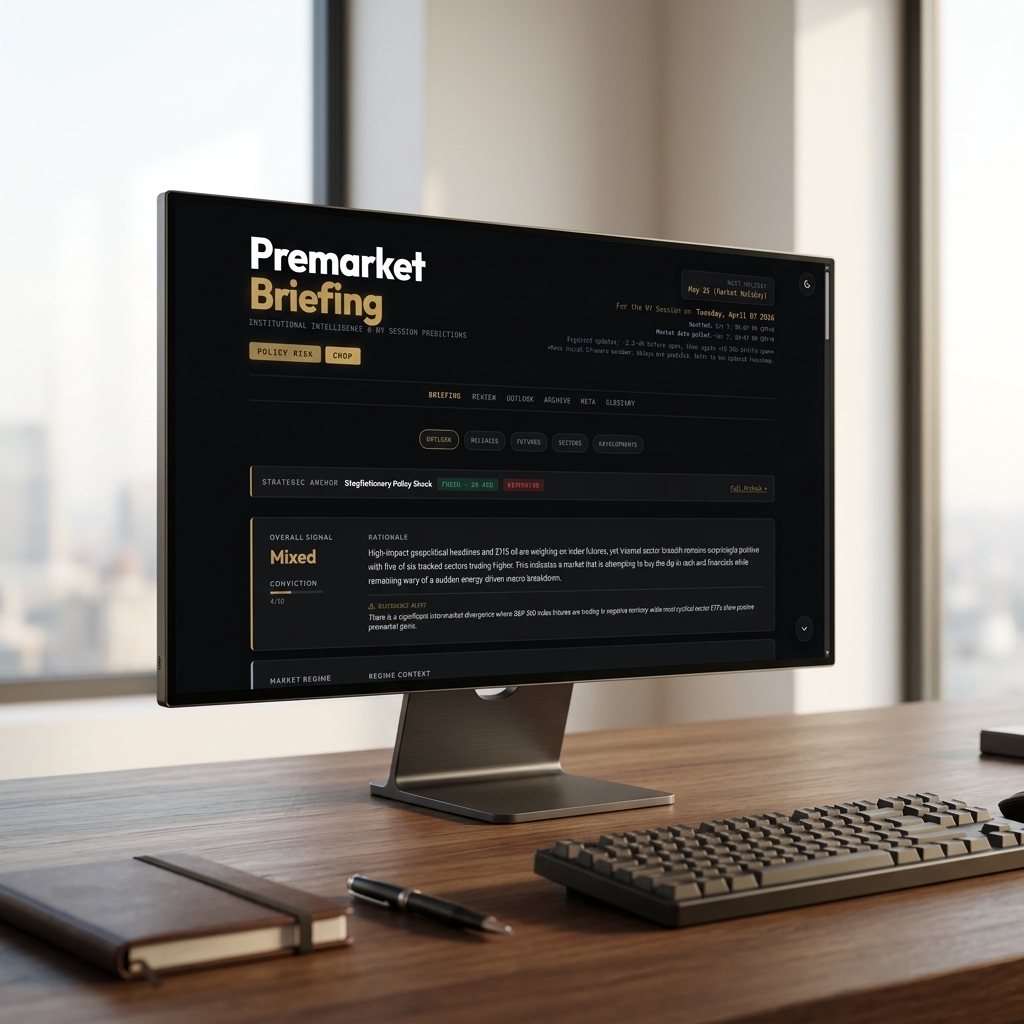
A self-reviewing market dashboard: morning briefings, evening scorecards, strategic outlooks, archive history, and a feedback loop that tries very hard not to lie to itself.
THESPARK
This started as a joke.
I was talking to a friend about the latest Trump headline and said, "Maybe I should just get Claude to build me a Trump Dashboard so we can see how the market reacts to whatever just happened." Very normal sentence. Extremely healthy hobby.
Then I realized I did not actually want a novelty dashboard glued to one man's shenanigans. I wanted something more durable: a market briefing that could wake up before I did, read the overnight mess, and tell me what kind of day I was probably walking into.
The real problem was much less dramatic: I kept showing up to the New York open underprepared. Not because I was ignoring the market, but because premarket is a soup. Futures are moving, yields are twitching, oil is reacting to another tan-Trump, three headlines contradict each other, and some economic release is waiting at 10:00 AM to ruin everyone's tidy little theory.
By the time you manually assemble a view, the opening move has often already happened. The trade is gone, the chart has done the thing, and you are left reading a beautiful briefing for a market that no longer exists.
So the question became: could I build something that does the boring morning prep on its own, publishes a useful read before the bell, and then checks itself after the close instead of pretending every forecast was genius?
THELAB
The current version is less "AI writes a market note" and more "small market operating system with a caffeine problem."
Every market morning, it pulls together the basic ingredients: index futures, sectors, macro data, scheduled economic releases, live news, market breadth proxies, and whatever strategic thesis is active at the time. It then turns that into a single-page premarket briefing written for an actual human, not for a committee trying to turn three bullet points into twelve pages.
The morning page tries to answer the questions I care about before the open:
- What is the likely shape of the session?
- Which stories actually matter today?
- Are sectors confirming the headline move, or is the index doing theatre?
- What data releases could flip the script?
- Is this aligned with the bigger strategic view, or is today's tape arguing with it?
After the close, the system comes back and grades the morning call. It compares the forecast with what actually happened: direction, sector leadership, narrative fit, session shape, conviction, and whether the key drivers were the right ones. The point is not to dunk on the model, though that is sometimes emotionally satisfying. The point is to build a record of where the system is sharp and where it keeps confidently stepping on the same rake.
That record feeds the meta-analysis loop. Once enough scored sessions have built up, the system reviews its own history and looks for patterns: maybe it is too good at the open and too optimistic about the close, maybe it keeps overreacting to a certain kind of macro headline, maybe the strategic thesis is still valid but getting noisier around the edges. When it finds a real pattern, it proposes changes for review instead of silently rewriting the rules in a dark room.
There is also a strategic outlook layer. That page zooms out from the daily noise and tracks the bigger thesis: what regime the market seems to be in, what would invalidate that view, which risks matter, and whether the daily briefings are lining up with the longer-term read. It is basically the dashboard saying, "Cool story this morning, but does this still fit the plot?"
The output is still simple on purpose: static pages, updated on a schedule, with a live briefing, evening review, strategic outlook, meta-analysis page, glossary, and archive. No login maze. No SaaS pricing table. No "Book a demo" button lurking in the corner like a threat.
THEMESS
The first big problem was the classic AI problem: the model was good at sounding right, which is not the same thing as being right.
Early versions could produce plausible news links that did not exist. Not obviously fake links, either. The headlines sounded real, the domains looked respectable, and then the URL would lead to nowhere. That is the worst kind of wrong: wrong in a blazer.
So the news flow became much stricter. The system fetches real articles first, scores and groups them, then only lets the model work from that supplied material. If a link was not handed to the model, it does not get to invent one. This made the output less magical, which is another way of saying more useful.
The second problem was stale data. A dashboard that updates automatically is great until it automatically publishes nonsense because one upstream source was late, broken, or still holding yesterday's values hostage. I added guardrails so the site would rather preserve the last valid briefing than overwrite it with a broken one. "Do nothing" is underrated as a reliability feature.
Macro releases were another source of pain. Economic data has a habit of arriving in stages: forecast, previous, preliminary, official, revised, whispered-about-by-someone-on-FinTwit, etc. The system had to learn the difference between "we are waiting for this number" and "this number is now known and should be judged against the morning scenario." That sounds boring. It was boring. It was also the difference between a dashboard that looks smart and one that can actually keep time.
The strategic layer created its own category of headaches. A long-term thesis is useful only if the system can also say when the thesis is aging, diverging, or invalidated. Otherwise it becomes financial astrology with nicer typography. The newer version tracks explicit invalidation rules and watch conditions, so the strategic page is not just inspirational prose about sectors going up eventually. It has to say what would make it wrong.
And then there was the archive problem. Once you keep enough daily briefings and reviews, old output stops being clutter and starts becoming product value. It becomes a decision journal: what did the system know that morning, what did it think, what happened later, and what did it learn? Getting that history into a usable shape made the project feel less like a dashboard and more like a small research lab with a very rigid bedtime.
THEREVEAL
What it produces now is a full loop.
Before the open, the dashboard publishes a morning read: expected session type, key stories, sector implications, macro events to watch, scenario branches, conviction, and how the day fits against the current strategic thesis.
After the close, it writes the scorecard: what the morning got right, what it missed, whether the thesis held up, and where the model's confidence was justified or embarrassing.
Over time, the meta-analysis page turns those individual scorecards into a system health report. It looks for repeat failure patterns and proposes adjustments, but keeps them human-reviewable. That matters because "the AI improved itself" sounds cool until you realize it might have simply taught itself a new way to be wrong.
The strategic outlook sits above the daily grind. It tracks the current market thesis, the supporting evidence, the warning signs, and the conditions that would force a rethink. The daily briefing can align with that view, diverge from it, or flag that the larger thesis is getting stale.
The archive ties it together. Every session becomes part of the record, so the dashboard is not just generating today's market opinion and immediately forgetting it. It keeps receipts.
That is the part I like most. The interesting bit is not that an AI can write a market summary. Lots of things can write summaries now. The interesting bit is the closed loop: make a call, preserve the call, compare it with reality, find the recurring mistakes, and feed that back into the next round.
It is not a trading oracle. It is not trying to be one. It is a disciplined premarket assistant that does the unglamorous work: read the tape, state the thesis, track the evidence, admit when the morning was wrong, and come back tomorrow slightly less naive.